.jpg&w=3840&q=75)
ByArian MahmudReviewed by:Yunus A. Polash
Human WrittenWhat Is Composable Architecture for Web Development?
Learn what composable architecture for web development is, how it works, its components, benefits, challenges, examples, and key comparisons.
Understanding What Is Composable Architecture for Web Development is important for businesses that need flexible, scalable, and easily upgradable digital platforms.
Composable architecture is a modern approach that builds websites and web applications using independent, reusable, and replaceable components connected through APIs.
Instead of relying on one large platform for content, ecommerce, search, payments, authentication, and analytics, businesses can choose specialized tools for each function.
This modular structure helps development teams launch features faster, replace outdated technologies more easily, and improve a website without rebuilding the entire system.
Composable Architecture in Web Development Explained
Composable architecture in web development treats each major business capability as an individual building block. These blocks can be developed internally or selected from different technology providers and then connected to form one complete digital experience.
For example, a business website might use:
- A headless content management system for publishing content
- A separate ecommerce platform for product and order management
- A specialized search service for product discovery
- An independent payment gateway for transactions
- A customer relationship management system for lead management
- A modern frontend framework for the user interface
Each solution performs a clearly defined task. APIs allow these solutions to exchange data and operate together as one coordinated system.
This approach differs from traditional platforms that bundle content, design, databases, business logic, and integrations into a single application. Composable development gives businesses more control over which technologies they use and how their digital platform evolves.
Companies planning a flexible digital platform can work with an experienced website design and development company to determine which components should be separated, integrated, or retained during development.
How Does Composable Architecture Work?
Composable architecture works by dividing a web platform into independent capabilities and connecting them through standardized interfaces. Each component has a specific responsibility and can usually be changed without requiring a complete rebuild of the other components.
The process generally follows five stages.
1. Business Capabilities Are Identified
The first step is to identify what the website must accomplish. A retail platform may need content publishing, inventory management, checkout, personalization, customer accounts, product recommendations, and analytics.
These requirements are treated as separate business capabilities rather than features that must come from one software vendor.
2. Suitable Components Are Selected
Developers then choose the most appropriate technology for each capability. This is often called a best-of-breed approach because businesses can select specialized solutions based on performance, cost, compatibility, and future needs.
A company may choose one provider for content management and another for ecommerce. The decision is based on the quality of each component rather than the limitations of an all-in-one platform.
3. APIs Connect the Components
Application programming interfaces allow individual services to communicate. For instance, the frontend can request product information from an ecommerce system, retrieve articles from a content platform, and send payment data to a secure payment provider.
API-based communication is a central part of composable development because it keeps individual components loosely coupled.
4. The Frontend Combines the Experience
The frontend presents data and functionality from different systems as one consistent experience. Visitors do not see the separate technologies operating behind the website.
Modern frontend frameworks can display content, products, customer information, and personalized recommendations while maintaining a unified visual identity.
5. Individual Components Are Improved Over Time
As business requirements change, teams can update or replace a specific service. A company could introduce a better search provider, add an AI recommendation tool, or move to a new CMS without replacing every part of its platform.
This ability to improve individual capabilities explains why composable systems are often selected by organizations expecting continuous growth or changing customer demands.
What Are the Components of Composable Architecture?
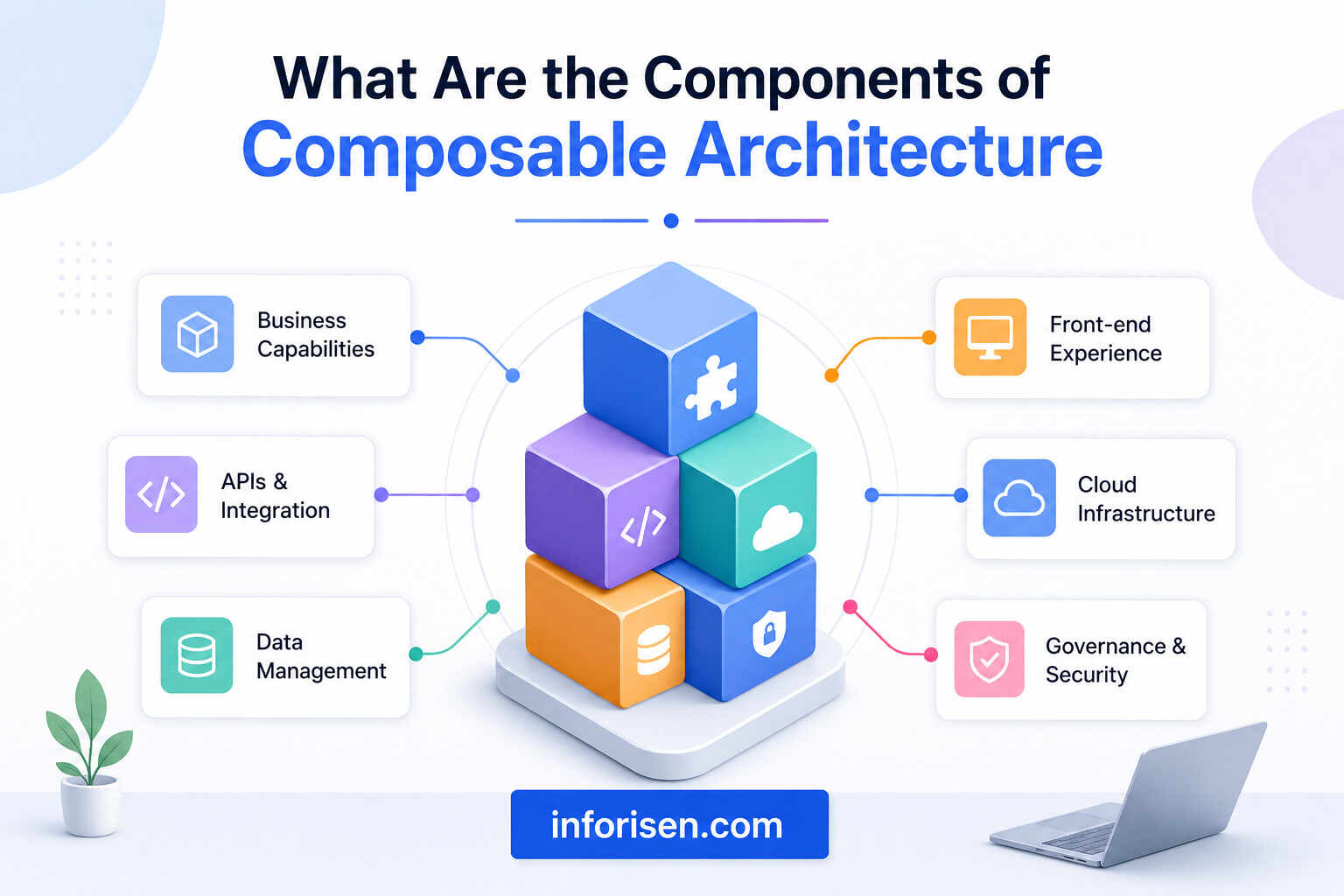
The exact components depend on the purpose of a website, but most composable systems include several common architectural elements.
Packaged Business Capabilities
Packaged business capabilities, commonly called PBCs, are independent software components designed around a specific business function. Examples include checkout, product search, customer profiles, pricing, booking, or content delivery.
A PBC may contain data, business logic, and APIs. It should provide a meaningful capability that can be reused or replaced without unnecessarily affecting the rest of the platform.
APIs and Integration Layers
APIs create communication channels between services. They allow components developed with different technologies to exchange information securely.
Some businesses also use integration platforms, middleware, or orchestration layers to manage more complicated workflows. These tools can coordinate requests, transform data, and reduce unnecessary dependencies between systems.
Headless Content Management
A headless CMS separates content management from content presentation. Editors manage content in the backend, while developers deliver it to websites, applications, mobile devices, or digital displays through APIs.
This separation supports flexible frontend development and consistent omnichannel content delivery.
Independent Frontend
The frontend controls what visitors see and how they interact with the platform. It may be built with frameworks such as React, Next.js, Vue, Nuxt, Angular, or another suitable technology.
Because the frontend is separated from backend services, design and development teams can improve the user experience without being restricted by the presentation layer of a traditional CMS.
Cloud Infrastructure
Cloud infrastructure supports deployment, storage, scalability, monitoring, and performance. Individual components can be hosted separately and scaled according to demand.
For example, the checkout service may require additional capacity during a major campaign, while the content system may continue operating at its normal level.
Governance and Monitoring
A composable platform still needs centralized governance. Development teams must manage security, API standards, service documentation, access permissions, performance monitoring, and vendor responsibilities.
Without proper governance, a modular platform can become difficult to maintain. The next consideration is whether the architectural benefits justify this additional responsibility.
Benefits of Composable Architecture for Websites
The main benefits of composable architecture for websites come from its flexibility. Businesses can make technology decisions according to current goals without permanently committing every website function to one platform.
Greater Development Flexibility
Developers can use suitable frameworks, programming languages, and services for different parts of a project. They are not required to follow the technical limitations of one vendor.
This flexibility can be particularly valuable for businesses with unique customer journeys or operational requirements.
Faster Feature Delivery
Independent teams can work on different capabilities simultaneously. One team may improve search while another updates customer accounts or introduces a new content section.
Because components are loosely connected, development work can move forward with fewer platform-wide dependencies.
Easier Technology Replacement
Businesses can replace an outdated or underperforming service without necessarily rebuilding the entire website. This reduces long-term dependence on a single technology vendor.
Contentful describes composable architecture as assembling digital capabilities from modular, API-based components rather than receiving every required function from one predefined platform.
Better Scalability
Different services can be scaled independently. This can improve resource management when one function receives considerably more traffic than another.
A high-traffic product catalogue, for example, may need more resources than a company’s static information pages.
Personalized Customer Experiences
Composable systems can connect specialized personalization, analytics, search, and customer-data tools. This gives businesses more options for creating experiences based on customer behaviour, location, purchase history, or preferences.
Support for Gradual Modernization
A company does not always need to replace its entire legacy platform immediately. It can gradually move selected capabilities into a composable structure.
This phased approach may reduce migration risk and make large transformation projects easier to manage.
However, these advantages must be considered alongside integration complexity, vendor management, security, and long-term maintenance costs.
Potential Challenges of Composable Web Development
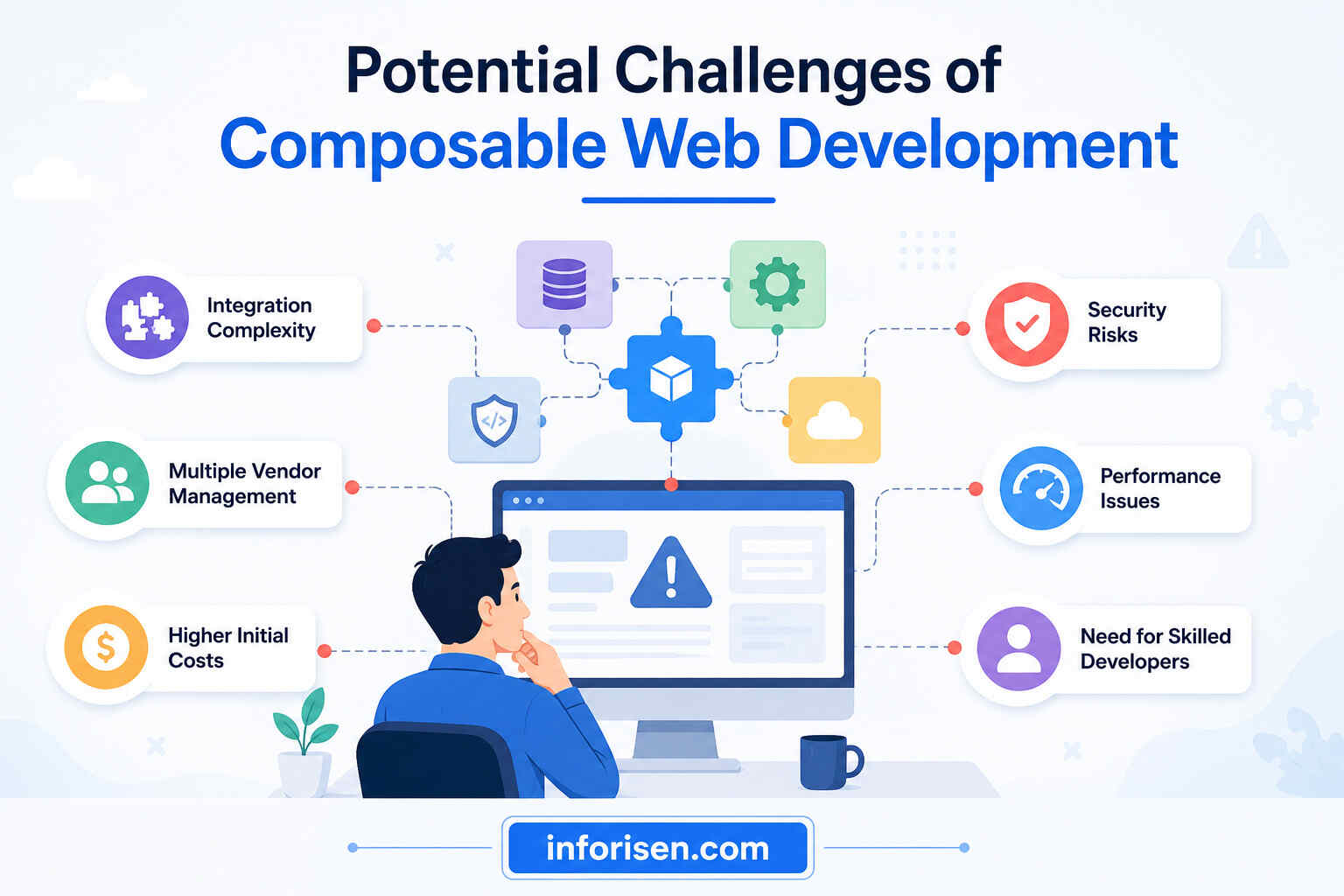
Composable architecture is not automatically the right solution for every website. Its flexibility can create additional technical and operational responsibilities.
Increased Integration Complexity
Every component must communicate reliably with the rest of the system. Poorly designed APIs, inconsistent data formats, or weak documentation may create performance and maintenance problems.
More Vendor Management
A composable platform may involve several technology vendors. Businesses must manage contracts, service limits, updates, security policies, and technical support across these providers.
Higher Initial Planning Requirements
Successful implementation requires a clear architectural strategy. Teams must understand which capabilities should remain independent and how data will move across the system.
Making every small website function a separate service can create unnecessary complexity.
Need for Skilled Development Teams
Developers must understand APIs, cloud deployment, integration patterns, frontend frameworks, security, monitoring, and data management.
Although automation continues to reshape development workflows, experienced professionals remain necessary for architectural decisions, quality control, security, and business alignment. The discussion about whether web developers will be replaced by AI is therefore closely connected to how development roles are changing rather than simply disappearing.
Performance and Reliability Risks
A request may travel through several external services before a page is displayed. If these connections are not carefully optimized, the website may experience slow loading or service failures.
Caching, fallback mechanisms, monitoring, and service-level agreements are important for reducing these risks.
Composable Architecture Examples
Practical composable architecture examples help illustrate how independent services can support one customer experience.
Composable Ecommerce Website
An online store could use:
- A headless CMS for landing pages and buying guides
- An ecommerce engine for products, pricing, and orders
- A search platform for filters and product discovery
- A payment provider for secure checkout
- A recommendation engine for personalization
- A separate frontend for the customer experience
The retailer can replace the search provider or introduce a new recommendation service without rebuilding the product-management system.
Hotel Booking Platform
A hotel platform may combine a content system, booking engine, customer database, payment service, review platform, map service, and multilingual frontend.
Each component supports a different stage of the booking journey while presenting customers with one coordinated interface.
B2B Customer Portal
A B2B company may connect account management, product catalogues, contract pricing, support tickets, invoicing, analytics, and document management.
This structure allows the portal to reflect complicated business rules without depending on one platform to manage every capability.
Publishing and Membership Platform
A digital publisher could connect a headless CMS, subscription service, authentication provider, advertising platform, recommendation engine, and analytics solution.
Teams can then improve subscription management or personalization independently from the editorial publishing workflow.
Complex projects like these often require coordinated frontend, backend, database, API, and deployment expertise. A professional full-stack web development service can help ensure the separate components function as one reliable platform.
Composable Architecture vs Monolithic Architecture
The difference between composable architecture vs monolithic architecture is mainly based on how capabilities are organized and changed.
| Area | Composable Architecture | Monolithic Architecture |
|---|---|---|
| Structure | Independent, connected components | Features contained in one application |
| Deployment | Components may be deployed separately | The application is often deployed as one unit |
| Vendor choice | Multiple specialized solutions can be used | Usually relies heavily on one platform |
| Flexibility | Individual services can be changed | Changes may affect the wider application |
| Initial simplicity | Requires architectural planning | Often easier to launch initially |
| Scaling | Capabilities can scale separately | The entire application may need scaling |
| Maintenance | Requires integration governance | Centralized but may become difficult as it grows |
| Best suited for | Complex, evolving digital platforms | Smaller or relatively stable applications |
A monolithic system can still be efficient for a small business website, prototype, or application with straightforward requirements. Research comparing monolithic and microservices-based systems also shows that distributed designs do not guarantee better performance in every configuration.
The appropriate choice depends on business complexity, expected growth, development resources, and how frequently the platform must change.
Composable Architecture vs Headless Architecture
The comparison between composable architecture vs headless architecture is sometimes confusing because the two approaches are related.
Headless architecture separates the presentation layer from the backend. Content or commerce data is delivered through APIs to an independently developed frontend.
Composable architecture is broader. It can include a headless frontend, but it also divides other business functions into modular components. Search, payments, customer data, recommendations, and authentication can all be independently selected.
| Headless Architecture | Composable Architecture |
|---|---|
| Primarily separates frontend and backend | Separates multiple business capabilities |
| May still use one large backend platform | Commonly combines several independent services |
| Provides frontend flexibility | Provides frontend and backend capability flexibility |
| Can be part of a composable system | Represents the wider architectural approach |
In simple terms, a website can be headless without being fully composable. A composable platform, however, frequently uses headless principles.
Composable Architecture vs Microservices
Composable architecture vs microservices is another comparison that requires a distinction between business strategy and technical implementation.
Microservices divide an application into small, independently deployable services. Each service generally manages a narrowly defined technical or business function.
Composable architecture focuses on assembling reusable business capabilities into a complete solution. Some of those capabilities may be powered by microservices, but businesses can also connect larger third-party platforms or software-as-a-service products.
Contentstack summarizes the distinction by explaining that composable architecture focuses on reusable and interchangeable modules, while microservices focus on independent services.
Therefore, microservices can support composability, but adopting microservices alone does not automatically create a well-designed composable platform.
Composable Architecture vs MACH Architecture
The difference between composable architecture vs MACH architecture becomes clearer when each term is treated at the correct level.
MACH stands for:
- Microservices-based
- API-first
- Cloud-native SaaS
- Headless
MACH describes a set of technical principles that can provide the foundation for composable systems. The MACH Alliance presents MACH as a pluggable and scalable foundation built around replaceable services and stable APIs.
Composable architecture is the wider approach of assembling independent business capabilities. MACH is one recognized way to implement that approach.
| Composable Architecture | MACH Architecture |
|---|---|
| Broad architectural and business approach | Defined collection of technical principles |
| Focuses on assembling business capabilities | Focuses on microservices, APIs, cloud and headless delivery |
| May use different implementation patterns | Provides a specific modern implementation model |
| MACH can support composability | MACH does not eliminate the need for business architecture |
Not every composable system must strictly follow every MACH principle. However, MACH technologies often make components easier to integrate, scale, deploy, and replace.
When Should a Business Use Composable Architecture?
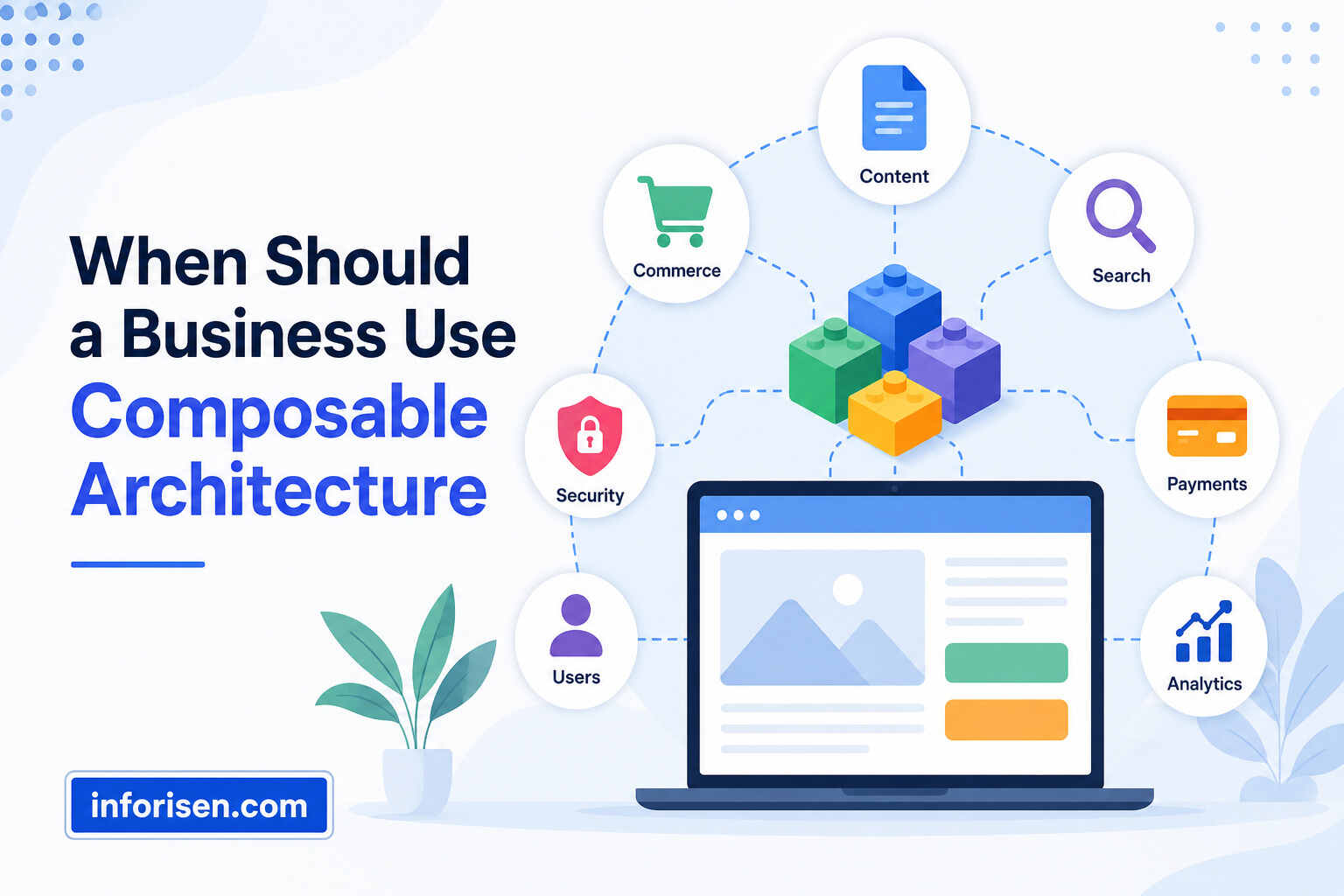
Composable architecture is most appropriate when a business has complex digital requirements and expects those requirements to change regularly.
It may be suitable when:
- The current platform restricts feature development
- Different customer channels need consistent data
- The business requires specialized third-party services
- Development teams need independent release cycles
- The website must support multiple regions or brands
- Traffic levels vary significantly across services
- Vendor lock-in has become a business concern
- Gradual modernization is preferred over a complete rebuild
A traditional platform may remain more practical when the website is small, the budget is limited, the feature set is stable, or the organization does not have sufficient integration expertise.
The best architecture is not always the one with the greatest number of modern technologies. It is the one that supports measurable business goals without introducing unnecessary operational complexity.
An experienced custom software development company can evaluate existing systems, customer journeys, technical debt, internal resources, and growth plans before recommending a composable migration.
How to Plan a Composable Architecture Project
A successful project should begin with business priorities rather than a collection of technology products.
Audit the Current Platform
Document the website’s existing services, integrations, content workflows, performance limitations, security requirements, and operational problems.
This reveals which areas require immediate improvement and which systems can continue operating.
Define Clear Capability Boundaries
Group requirements into meaningful business capabilities such as content, checkout, customer identity, pricing, or search.
Avoid separating functions simply because the technology allows it. Every boundary should support ownership, scalability, replacement, or independent development.
Prioritize High-Value Improvements
Start with a capability that creates a clear business impact. This could be faster content publishing, improved search, better checkout performance, or support for a new sales channel.
Early measurable results can help justify further modernization.
Establish Integration Standards
Define API formats, authentication methods, error handling, documentation, monitoring, and data ownership before connecting numerous services. Consistent standards reduce maintenance problems as the platform expands.
Introduce Components Gradually
Many organizations benefit from replacing one capability at a time. This approach is sometimes described as incremental or strangler-pattern modernization.
The existing platform remains operational while selected functions move to the new architecture.
Measure Business and Technical Results
Track conversion rates, development speed, deployment frequency, uptime, page performance, infrastructure cost, error rates, and customer satisfaction.
These measurements show whether the composable model is producing genuine value rather than only increasing technical sophistication.
Final Words
Understanding what is composable architecture for web development helps businesses decide whether this modular approach supports their digital goals.
It builds websites and applications from independent, API-connected components that can be selected, reused, scaled, or replaced as requirements change.
Its main advantage is flexibility, allowing businesses to avoid relying on one platform for content, commerce, payments, search, customer data, and frontend delivery. However, it also requires careful integration, security, governance, and vendor management.
With clear planning and skilled development, composable architecture can create a scalable digital foundation that evolves with customer expectations.
Frequently Asked Questions
Composable architecture is a way of building a website or application by connecting separate software components. Each component performs a specific function and can be updated or replaced without rebuilding the entire platform.
It works by dividing a digital platform into independent business capabilities and connecting them through APIs. A separate frontend combines the information and functions from these services into one user experience.
Common components include packaged business capabilities, APIs, a headless CMS, an independent frontend, cloud infrastructure, integration tools, security controls, and monitoring systems.
No. Headless architecture mainly separates the frontend from the backend. Composable architecture goes further by separating multiple capabilities, such as content, search, checkout, payments, and customer data.
It can use microservices, but microservices are not mandatory for every component. A composable platform may combine microservices, third-party SaaS tools, headless platforms, and internally developed applications.
Composable architecture is the broad approach of assembling independent business capabilities. MACH is a set of technical principles—microservices, API-first, cloud-native SaaS, and headless—that can support a composable system.
It can be used for small websites, but it may introduce more complexity than necessary. A traditional CMS or unified platform is often more cost-effective when requirements are simple, stable, and unlikely to require frequent integrations.


.webp&w=3840&q=75)



.jpg&w=3840&q=75)