ByArian MahmudReviewed by:Yunus A. Polash
Human WrittenWhat Is SEO Strategy in Marketing? A Complete Guide for Businesses
Understand what SEO strategy in marketing means, explore its key components and benefits, and discover how to create an effective SEO strategy for business growth.
A successful online presence needs more than a website and occasional content. What is SEO strategy in marketing is essentially about creating a clear plan to improve search visibility, attract the right audience, and turn organic traffic into meaningful business results.
What Is an SEO Strategy?
An SEO strategy is a structured plan that helps a website become more visible in organic search while supporting specific marketing and business goals. It combines keyword research, content creation, technical optimization, on-page SEO, internal linking, authority building, and performance measurement.
Instead of treating SEO as a collection of unrelated tasks, a strategy connects each activity to a specific objective. For example, an e-commerce website may focus on product visibility and sales, while a B2B company may prioritize qualified leads and industry authority. Understanding what is an SEO strategy also means understanding that rankings are not the only goal. The strategy should help the right people discover the right pages at the right stage of their buying journey.
A good plan therefore starts with the audience, business objectives, competitors, and search behavior. From there, marketers can decide which topics, keywords, pages, and optimization activities deserve priority.
What Is SEO in Marketing?
SEO in marketing is the process of improving a website so potential customers can discover its content, products, or services through unpaid search results. It connects what people search for with useful pages that address their needs. For beginners, what is SEO and how it works provides a useful foundation for understanding how crawling, indexing, ranking, search intent, content, and technical factors connect to organic visibility.
Why Does SEO Matter in Marketing?
SEO matters because it can help businesses increase brand awareness, attract relevant website traffic, generate leads, support sales, and build long-term visibility in search results. Unlike advertising, organic search does not require a business to pay for every individual click.
A strong SEO strategy in digital marketing can also complement paid advertising, social media, email marketing, and other acquisition channels. Each channel can play a different role within the overall customer journey. Once you understand what SEO is and why it matters, the next step is to explore what an effective SEO strategy actually contains.
Why Is SEO Strategy Important in Marketing?
SEO strategy is important because it gives businesses a structured way to attract people who are actively searching for relevant information, products, or services. Simply receiving website traffic does not necessarily create business value. The visitors need to be relevant, the content needs to match their intent, and the website needs to provide a clear path toward the next action.
A well-planned strategy can help a business:
- Increase organic search visibility
- Attract qualified visitors
- Build topical authority
- Improve brand credibility
- Generate leads
- Increase sales opportunities
- Reduce dependence on paid traffic
- Create long-term content assets
- Improve the customer journey
This is why SEO strategy is important in marketing is more than a ranking question. SEO becomes much more valuable when search visibility is connected to measurable business outcomes.
It is also important to understand the difference between organic SEO and paid search. Businesses can invest in Google Ads for sponsored visibility, but they cannot purchase a higher organic ranking from Google.
Can you pay Google to rank higher? it explains the distinction between paid advertising and organic SEO in detail. With that foundation established, we can look at the main elements that make a strategy work.
What Are the Components of an SEO Strategy?
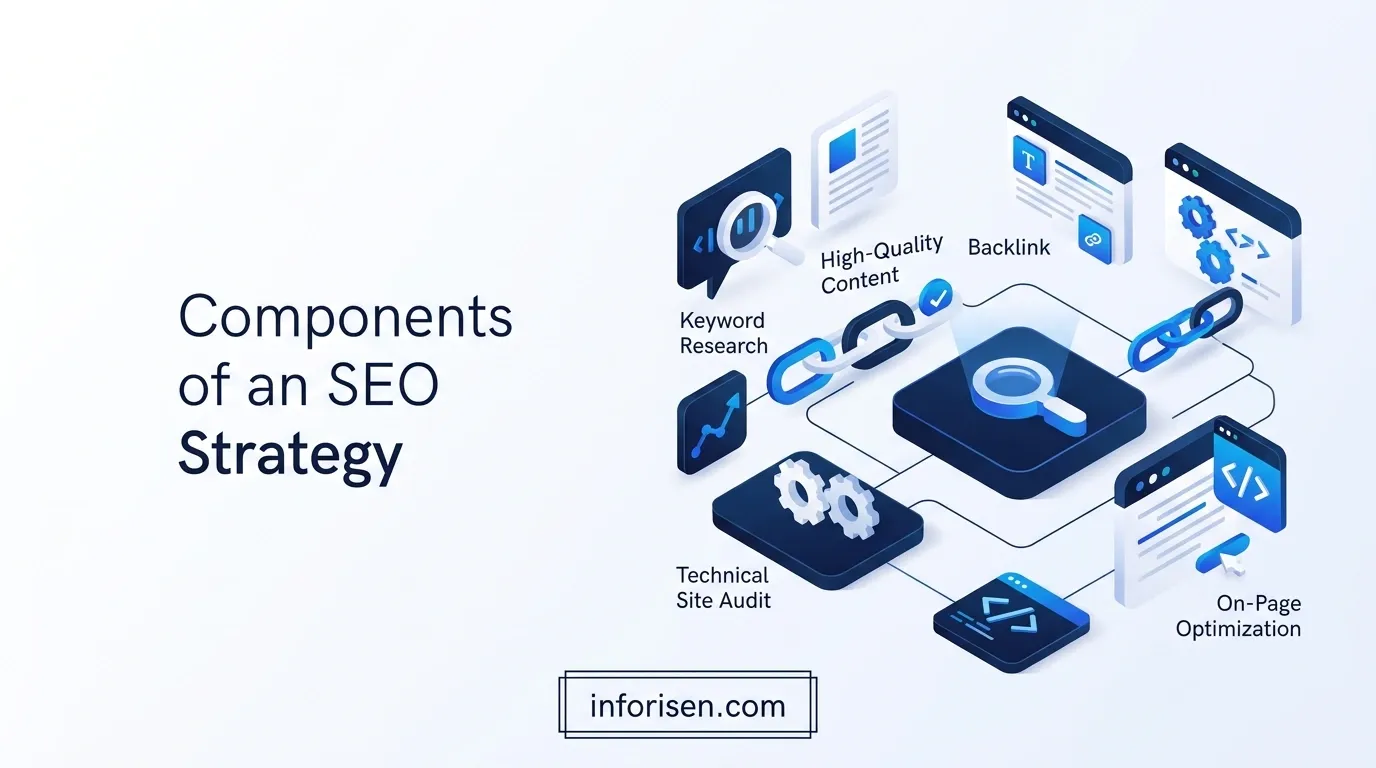
The components of an SEO strategy work together to improve relevance, accessibility, authority, and user experience.
The most important areas usually include keyword research, search intent, technical SEO, content, on-page optimization, internal linking, off-page authority, and measurement.
SEO Strategy and Keyword Research
Keyword research identifies the terms, questions, and problems your target audience searches for. However, effective SEO strategy and keyword research should not focus only on search volume. Search intent is equally important because two similar keywords can represent completely different needs.
For example, someone searching “what is SEO strategy” is likely looking for an explanation, while someone searching “SEO strategy services” may be comparing providers. A useful keyword map should therefore include informational, commercial, transactional, navigational, and local opportunities where appropriate.
Technical SEO
Technical SEO makes it easier for search engines to crawl, render, understand, and index website pages.
Important areas include:
- Website architecture
- Crawlability
- Indexation
- XML sitemaps
- Robots directives
- Canonical URLs
- Redirects
- Mobile usability
- Page performance
- HTTPS
- Structured data
Technical SEO creates the foundation for the rest of the strategy. If important pages cannot be discovered or indexed properly, even excellent content may struggle to perform.
Content Strategy
Content gives search engines and users information that satisfies specific search needs.
A strong content strategy does not mean publishing as many articles as possible. It means creating useful resources around topics that matter to the target audience.
For example, an SEO company could create a central guide about SEO strategy and then support it with content about keyword research, technical SEO, local SEO, content marketing, SEO pricing, SEO services, and choosing an SEO provider.
This structure can help create stronger topical relationships between related pages.
On-Page SEO
On-page SEO involves optimizing elements directly on a webpage.
This includes:
- Title tags
- Headings
- Relevant terminology
- Search intent
- Content structure
- Internal links
- Image optimization
- URLs
- Meta descriptions
- Helpful FAQs
The goal is not to repeat the same keyword throughout the page. Instead, the content should communicate its subject clearly and naturally cover related concepts.
Off-Page SEO
Off-page SEO focuses on building credibility and authority beyond the website itself.
Relevant backlinks, digital PR, brand mentions, partnerships, and editorial references can contribute to a website's authority.
Quality is more important than simply collecting a large number of links. Links should come from relevant and trustworthy sources whenever possible.
What Are the 4 Pillars of SEO Strategy?
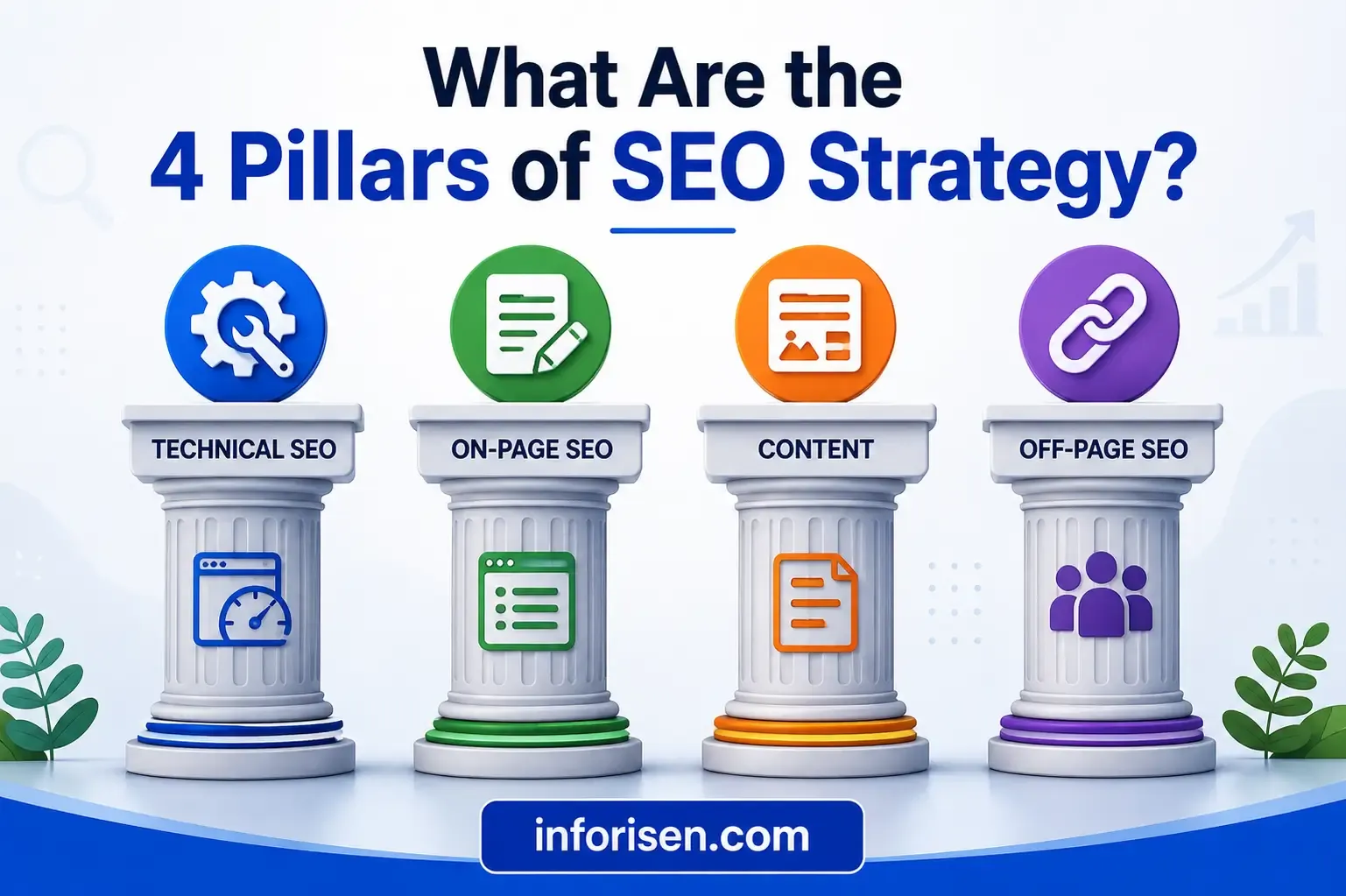
The four commonly discussed pillars are technical SEO, on-page SEO, content, and off-page SEO.
These pillars should not operate independently. For example, publishing excellent content is less effective if important pages cannot be indexed. Similarly, a technically strong website may not attract customers if it does not provide useful answers to relevant searches.
The strategy becomes stronger when all four areas support the same business objective.
How Does SEO Strategy Work?
An SEO strategy works by connecting business goals with the search behavior of a target audience. The process normally starts by understanding what the business wants to achieve. The next stage is researching customers, competitors, keywords, search intent, and existing website performance.
Marketers can then create a roadmap covering technical improvements, content opportunities, landing pages, internal links, authority building, and conversion optimization.
The process can be simplified as:
Research → Plan → Optimize → Publish → Measure → Improve
This cycle is ongoing because search behavior, competitors, products, and customer expectations change over time.
A successful strategy therefore does not stop after publishing a few articles. Performance data should continuously influence what gets improved, expanded, updated, or created next.
How to Create an SEO Strategy Step by Step
Creating a useful SEO plan becomes easier when the process follows a logical sequence.
1. Define Your Business Goals
Start by identifying what you want SEO to accomplish. Your objective could be generating leads, increasing product sales, attracting local customers, improving brand visibility, or increasing qualified website traffic. The goal determines which keywords and pages should receive the most attention.
2. Identify Your Target Audience
Understand who your potential customers are and what problems they are trying to solve. Look at their questions, concerns, purchasing motivations, objections, and preferred solutions. This helps you create content that responds to real customer needs rather than simply targeting keywords.
3. Research Keywords and Search Intent
Create a keyword list based on what your audience actually searches for. Then categorize those searches according to intent. Informational searches may require educational articles, while commercial searches may require service pages, comparisons, or case studies.
4. Analyze Competitors
Study websites that already rank for your target searches. Look at their content depth, page structure, internal links, authority, user experience, and the topics they cover. Competitor analysis can reveal content gaps and opportunities that are easier to target.
5. Build Topic Clusters
Organize related keywords and questions into logical topic groups. A broad pillar page can introduce a subject, while supporting articles answer more specific questions. Internal links then connect the related resources. This approach helps build topical depth instead of creating dozens of disconnected pages.
6. Improve Technical SEO
Fix technical issues that could prevent search engines from properly accessing or understanding your website. Prioritize important problems first rather than spending resources on minor technical details that have little business impact.
7. Create Helpful Content
Create pages that directly satisfy the searcher's intent. Answer the primary question early, then provide supporting information, examples, comparisons, practical advice, and relevant next steps.
8. Build Authority
Promote valuable content and work toward earning relevant mentions and backlinks. Authority should develop naturally through useful resources, expertise, relationships, digital PR, and strong content.
9. Measure Performance
Track organic clicks, impressions, rankings, qualified traffic, conversions, leads, and revenue where appropriate. The final objective is not simply to rank. It is to generate useful business outcomes.
How to Develop an SEO Marketing Strategy for a Business
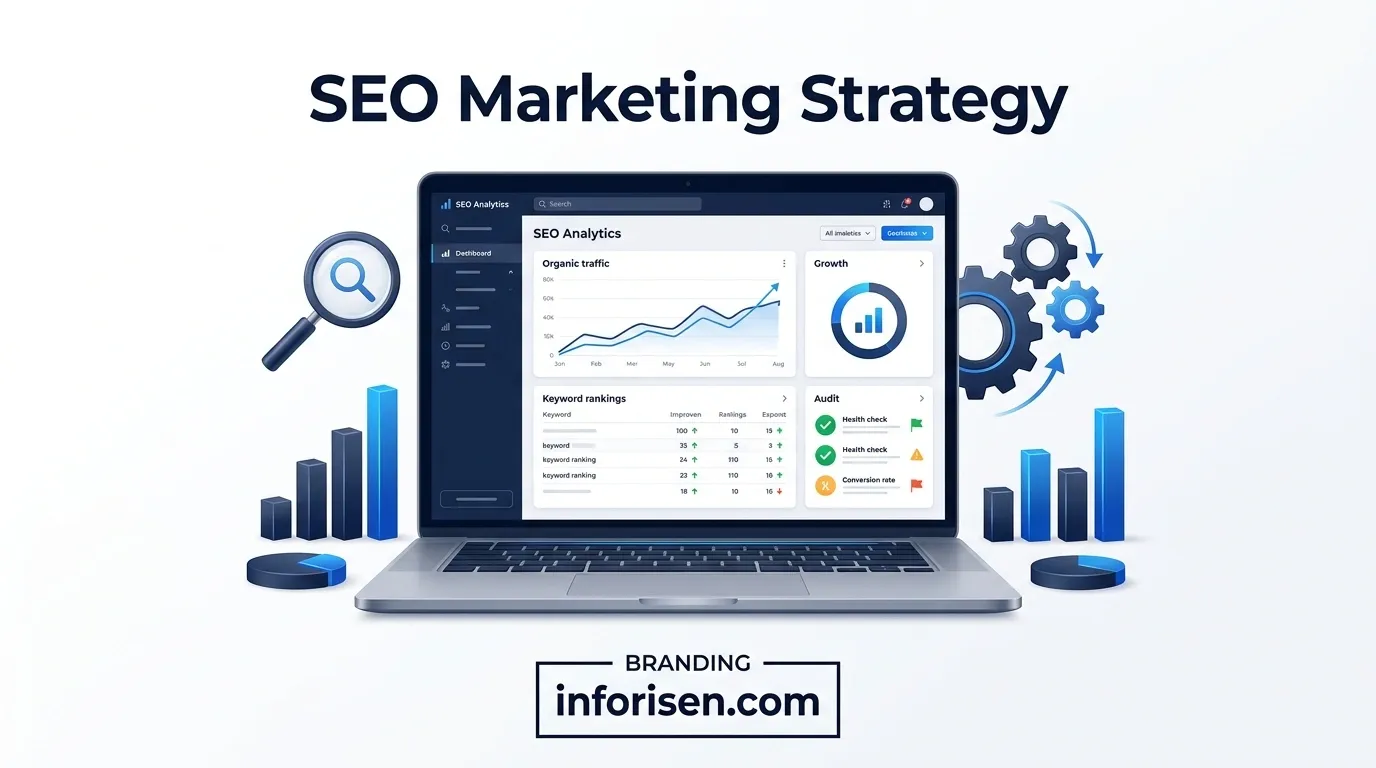
A business-focused strategy should connect search visibility with the customer journey. Suppose a web development company wants to attract businesses searching for website solutions. It could create educational content around web development, commercial service pages, pricing information, comparison guides, industry-specific pages, and case studies. Someone researching “what is website development” may still be learning. Another person searching for “web development company” is much closer to choosing a provider.
A successful how to develop an SEO marketing strategy approach recognizes these differences and creates content for each stage.
This is also where internal linking becomes valuable. Informational pages can naturally guide users toward relevant commercial pages without making the content feel like an advertisement.
SEO Strategy for Small Businesses
An SEO strategy for small businesses should focus on realistic opportunities instead of trying to compete for every broad, high-volume search.
Small businesses can often benefit from:
- Local search terms
- Service-specific keywords
- Long-tail queries
- Location-based pages
- Customer questions
- Niche topics
- Comparison content
- Case studies
- Service landing pages
For example, a local SEO company may have a better opportunity targeting a specific service within a particular market than trying to rank nationally for “SEO.” The best opportunity is usually where relevance, competition, search intent, and commercial value overlap.
SEO Strategy for Businesses: From Traffic to Revenue
An SEO strategy for businesses should ultimately connect organic visibility to revenue.
That means identifying which searches are likely to attract potential customers and creating pages that help those visitors move toward a conversion.
For example:
Search → Helpful content → Related service → Trust signals → Contact or purchase
This journey can be different for every business. An e-commerce company may guide users from buying guides to product categories. A B2B company may move visitors from educational articles to solution pages, case studies, and consultation forms. SEO becomes more valuable when every important page has a clear purpose within that journey.
SEO Marketing Strategy Examples
Different business models require different approaches.
Local Service Business
A local service provider can target location-specific searches, service pages, FAQs, customer problems, and local information.
The strategy should make it easy for nearby customers to understand what the business offers and how to contact it.
E-commerce Business
An e-commerce website can combine category pages, product pages, buying guides, comparisons, and informational content.
The objective is to capture customers across different stages of product research and purchasing.
B2B Company
A B2B company may need a longer content journey.
It can create educational guides, industry pages, solution pages, comparison content, case studies, and detailed service resources.
These SEO marketing strategy examples demonstrate why SEO should be customized according to the business model instead of copied from another website.
SEO Strategy vs SEO Tactics
SEO strategy and SEO tactics are related but not identical.
A strategy defines where you want to go and why, while tactics describe what you will do to get there.
Publishing an article is a tactic. Deciding which topic that article should target because it supports a broader business goal is strategy.
Keeping this distinction clear helps prevent businesses from spending time on SEO activities that do not contribute to meaningful results.
How Can an SEO Strategy Increase Organic Traffic?
An SEO strategy to increase organic traffic focuses on earning visibility for a collection of relevant searches rather than relying on one keyword. This usually involves improving existing pages, creating new content, targeting search intent, strengthening internal linking, resolving technical problems, and developing website authority.
However, traffic should not be treated as the final metric. A website receiving 10,000 irrelevant visitors may produce less business value than another website receiving 1,000 highly relevant visitors who become customers. Therefore, the goal should be qualified organic traffic, not traffic at any cost.
How Does Google Fit Into an SEO Strategy?
A Google SEO strategy should focus on helping search engines understand the website while providing genuinely useful information to users. Google's organic results are not something businesses can simply purchase. Businesses can pay for Google Ads, but advertising expenditure does not buy a higher organic ranking.
The distinction between paid and organic visibility is important when developing an SEO budget. Money can be spent on professional SEO work, content, technical improvements, UX, and authority building, but there is no legitimate payment that guarantees the number-one organic position. A good SEO strategy therefore focuses on improving the website itself rather than trying to purchase rankings.
When Should a Business Invest in SEO Strategy Services?

Businesses often consider SEO strategy services when they have a website but lack consistent organic growth, do not know which keywords to target, face strong competition, or want a structured plan for generating qualified search traffic. Professional SEO support can be particularly valuable when the project involves multiple areas such as technical SEO, content planning, competitor research, internal linking, authority building, analytics, and conversion optimization.
However, choosing a provider requires careful evaluation. Before hiring an SEO company, businesses should examine its experience, methodology, reporting, communication, pricing, case studies, and ability to connect SEO work with business objectives. The guide on how to choose an SEO company covers important factors businesses can consider when evaluating an SEO provider.
SEO Strategy Consultant vs SEO Strategy Agency
The right choice between an SEO consultant and an agency depends on the resources and complexity of the business. An SEO consultant may be suitable when a company already has writers, developers, and marketers but needs expert strategic direction. An agency may be more appropriate when the company wants a broader team to handle research, technical optimization, content, link building, reporting, and ongoing implementation.
The important thing is not the title of the provider. Look at the process, transparency, expertise, communication, and measurable outcomes. Avoid providers that focus entirely on guaranteed rankings without explaining how they plan to improve the website.
How Do You Measure an SEO Strategy?
SEO performance should be measured using metrics that connect search visibility with business results.
Important metrics can include:
- Organic impressions
- Organic clicks
- Search visibility
- Keyword performance
- Qualified organic traffic
- Conversion rate
- Leads
- Sales
- Revenue
- Cost per acquisition
- Assisted conversions
- Engagement with important pages
Rankings are useful, but they are only one part of the picture. For example, ranking first for a keyword with no commercial value may not be as useful as ranking highly for several searches that consistently generate qualified leads. A mature SEO strategy therefore measures both search performance and business performance.
Frequently Asked Questions About SEO Strategy
What is an SEO strategy in simple terms?
An SEO strategy is a plan for improving a website's organic search visibility while attracting the right audience and supporting business goals. It combines keyword research, content, technical optimization, authority building, and performance measurement.
Why is SEO strategy important for a business?
SEO strategy helps businesses attract people who are already searching for relevant products, services, or information. A well-planned approach can increase visibility, qualified traffic, leads, and long-term customer acquisition.
How long does an SEO strategy take to work?
SEO results vary depending on competition, website authority, technical condition, content quality, industry, and the keywords being targeted. Some improvements may produce relatively quick results, while competitive searches can require sustained effort over a longer period.
What are the main components of an SEO strategy?
The main components include keyword research, search-intent analysis, technical SEO, on-page optimization, content creation, internal linking, authority development, and performance measurement.
Can SEO guarantee a Google ranking?
No. A legitimate SEO provider cannot guarantee a specific organic Google position. Businesses can invest in SEO work that improves their ability to compete, but organic rankings are not sold by Google.
Is SEO better than Google Ads?
Neither is automatically better. Google Ads can provide immediate paid visibility, while SEO focuses on building long-term organic visibility. Many businesses can benefit from using both with different objectives.
Should small businesses invest in SEO?
Small businesses can benefit from SEO when their customers use search engines to find relevant products or services. The strategy should focus on realistic, high-intent opportunities instead of competing for every broad keyword.
Final Thoughts
A successful SEO plan is much more than adding keywords to webpages or publishing articles regularly. What is SEO strategy in marketing ultimately means is creating a coordinated system that connects business goals, customer needs, search intent, useful content, technical quality, authority, and measurable results.
The strongest strategies begin with clear objectives and audience research, identify valuable search opportunities, build topical depth, improve the website's technical foundation, and continuously measure performance.
For businesses considering professional SEO, the priority should be finding a strategy that focuses on sustainable visibility and qualified customers rather than unrealistic ranking promises. When SEO is treated as a long-term marketing investment, it can become a reliable channel for building visibility, authority, leads, and business growth.



.webp&w=3840&q=75)
.webp&w=3840&q=75)