.webp&w=3840&q=75)
ByArian MahmudReviewed by:Yunus A. Polash
Human WrittenHow SEO Works in Digital Marketing: A Complete Guide to Organic Growth
Discover how SEO works in digital marketing and how keyword research, content, technical SEO, internal linking, authority, and user experience work together to drive organic traffic and sustainable business growth.
Digital marketing works best when people can discover a business at the moment they need information, a solution, a product, or a service. SEO makes that discovery possible through organic search. Understanding how SEO works in digital marketing is not only about learning how Google ranks pages. SEO connects search demand with useful content, a technically strong website, brand authority, user experience, and conversion opportunities. It can support customers from their first question to their final buying decision.
This guide explains how SEO fits into a complete digital marketing strategy, how the process works, how it supports other marketing channels, and how businesses can use it for sustainable growth.
What Is the Role of SEO in Digital Marketing?
SEO, or search engine optimization, improves a website so that relevant pages can become more visible when people search for related information, products, or services. Within a digital marketing strategy, SEO acts as an organic discovery channel.
A potential customer might search for:
- how to solve a particular problem
- the best product for a specific need
- a service provider in their area
- a comparison between two solutions
- reviews about a company
- pricing information
- instructions or educational resources
SEO helps a business create the right page for those moments. If you need a deeper explanation of crawling, indexing, and ranking, Inforisen's guide to what SEO is and how it works explains the search engine process in more detail. The important point for digital marketers is that SEO does not operate alone. It supports content marketing, website development, branding, conversion optimization, paid campaigns, and the wider customer journey.
How Does SEO Fit Into a Digital Marketing Strategy?
A digital marketing strategy normally uses several channels to reach and influence customers.
These may include:
Inforisen's broader digital marketing services combine areas such as SEO, PPC, content strategy, social media, email marketing, and performance measurement. That integrated approach matters because a visitor rarely interacts with a business through only one channel.
Someone may first discover an article through Google, later see the company on social media, return through a branded search, read a service page, and finally submit a contact form. SEO may begin that journey even when another channel receives the final conversion.
How SEO Works in Digital Marketing Step by Step
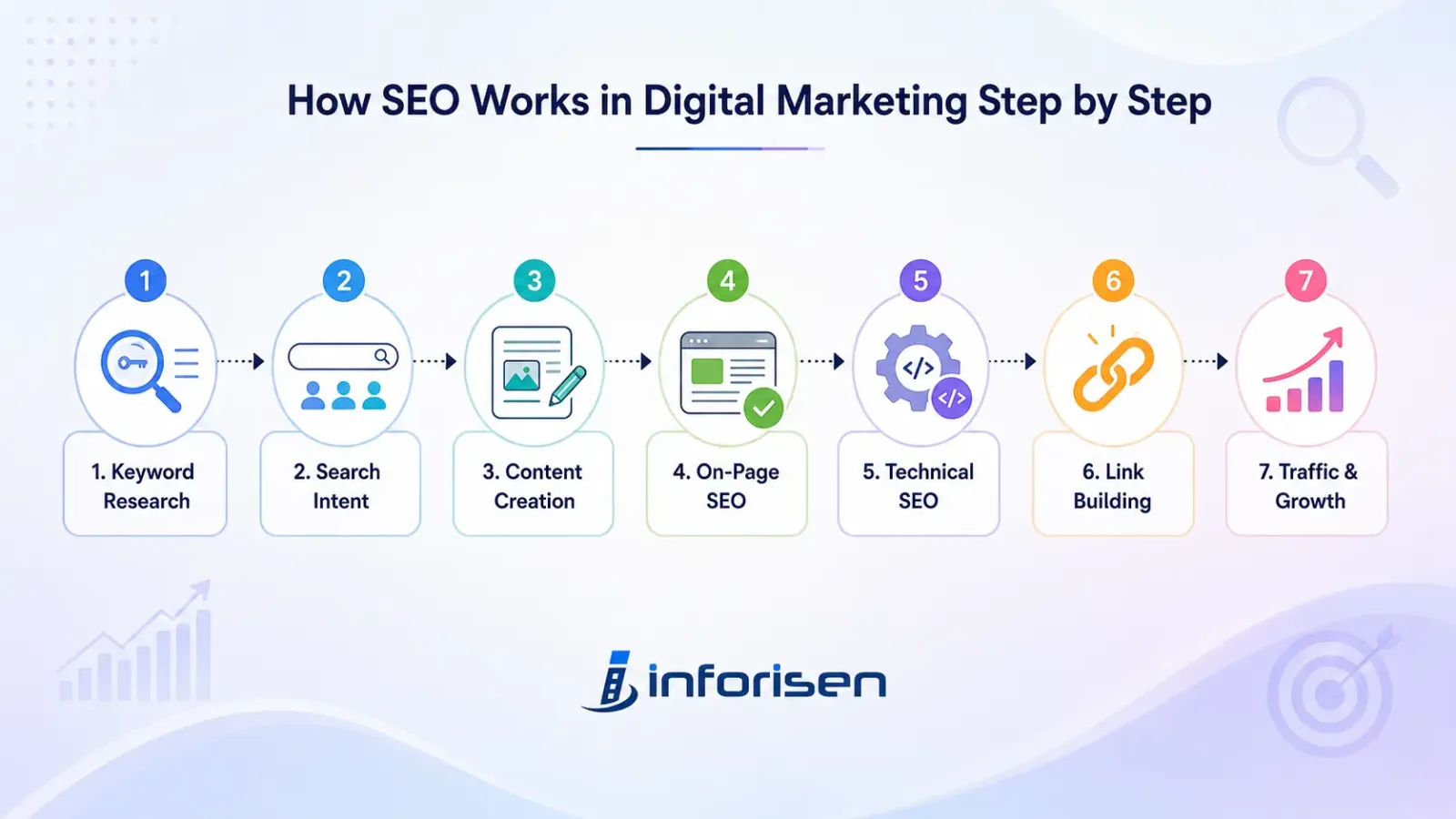
SEO becomes easier to understand when viewed as a continuous marketing system rather than a list of technical tasks. The process usually moves from understanding customer demand to creating relevant experiences and then measuring whether those experiences generate useful business outcomes.
1. SEO Starts With Understanding What People Search For
Every successful SEO strategy starts with the audience. Businesses need to understand the questions, problems, needs, products, services, and comparisons people search for. This is where keyword research becomes useful.
For example, an SEO agency might identify searches such as:
- what is SEO
- how does SEO work
- SEO services for small businesses
- local SEO company
- technical SEO audit
- SEO company for ecommerce
- how much does SEO cost
- SEO vs PPC
However, keywords should not be selected only because they have high search volume. Business relevance and search intent are equally important. A phrase that receives 200 searches from highly relevant potential customers may provide more business value than a broad keyword receiving 20,000 searches from people who are unlikely to convert.
Inforisen's guide on how important keywords are in SEO explains why modern keyword strategy requires relevance, context, intent, and topical depth rather than simple keyword repetition.
2. Search Intent Determines What Type of Content You Need
Search intent describes what a person is trying to accomplish with a search. Most searches can broadly fall into several categories:
Informational intent:
The user wants to learn something.
Example: “how does local SEO work?”
Commercial investigation:
The user is comparing available options.
Example: “best SEO company for startups”
Transactional intent:
The user may be ready to take action.
Example: “hire technical SEO agency”
Navigational intent:
The user wants a particular website or company.
Example: “Inforisen SEO services”
Understanding this difference is critical.
Imagine creating a 3,000-word educational article for a keyword where users mainly want to hire an agency. Even excellent writing may struggle because the page does not match what the searcher expects.
SEO therefore begins with a simple question: "What would genuinely satisfy the person making this search?" The answer determines whether you need a blog post, service page, category page, comparison, landing page, product page, FAQ, tool, case study, or another format.
3. SEO Maps Search Demand Across the Customer Journey
One of SEO's biggest strengths in digital marketing is its ability to reach potential customers at different stages of awareness.
Consider this journey:
This makes SEO more than a traffic-generation tactic. It can become an acquisition system that helps potential customers move from discovering a problem to evaluating a solution. Longer and more specific searches can be especially useful at later stages because they often reveal more context about what a person actually needs. Inforisen's guide to long-tail keywords covers how these specific queries can support targeted content planning.
4. Search Engines Must Be Able to Access and Understand the Website
Great marketing content cannot generate much organic visibility if search engines cannot properly access the website.
Technical SEO creates the foundation. Google broadly describes Search as involving crawling, indexing, and serving relevant results. Pages must be accessible and understandable before they can compete effectively in search.
Technical SEO can involve:
- crawlability
- indexation
- XML sitemaps
- robots directives
- canonical URLs
- redirects
- mobile usability
- HTTPS
- website architecture
- page performance
- structured data
- JavaScript rendering
- duplicate URL management
- broken links
- status codes
Digital marketers do not always need to personally fix every technical issue, but they should understand how technical problems affect campaign performance. For example, investing heavily in content promotion makes little sense if important landing pages are accidentally blocked from indexing. This is why SEO and website design and development should work together instead of being treated as completely separate projects.
5. Content Is Created Around Real Search Problems
Once marketers understand search demand and website accessibility, they can create content designed to solve real user problems.
Strong SEO content is not simply an article containing a target keyword several times. It should answer the main question clearly while covering the supporting information users need.
For example, an article about ecommerce SEO could naturally discuss:
- category pages
- product descriptions
- product schema
- site architecture
- internal links
- duplicate content
- faceted navigation
- product reviews
- transactional keywords
- page speed
- conversion optimization
These related concepts create topical depth naturally. This is sometimes described as semantic SEO. Instead of writing mechanically for one exact keyword, the content develops a complete topic that both people and search systems can understand. Google recommends creating helpful, reliable, people-first content and writing naturally rather than excessively repeating keywords.
6. On-Page SEO Makes Each Page Clearer
After useful content exists, on-page SEO helps communicate the purpose of the page.
Common on-page elements include:
- Page title
- H1 heading
- H2 and H3 structure
- Introduction
- Search intent alignment
- Supporting keywords and entities
- Image alt text
- Internal links
- Descriptive URLs
- Calls to action
Each element should help the page become easier to understand rather than simply creating another place to insert a keyword.
For example, a heading called:
Benefits- provides very little context.
A clearer version might be:
How SEO Helps Businesses Generate Qualified Organic Traffic
The second heading tells both the reader and search systems much more about what follows.
7. Internal Linking Connects Content Into a Useful Website Structure
Internal links connect one page of a website to another. They serve several purposes at once. They help visitors discover related information, distribute attention toward important pages, establish relationships between topics, and give search engine crawlers paths through the website.
Google specifically recommends making important content discoverable through crawlable internal links. Consider a digital marketing website with separate pages about:
- SEO
- PPC
- digital marketing
- website development
- content marketing
- local SEO
- keyword research
- technical SEO
These topics should not exist as isolated pages. A useful article about digital marketing can introduce SEO and naturally direct readers to relevant professional SEO services. A keyword research article might link to a long-tail keyword guide. A technical SEO article might connect to website development. This creates a logical information ecosystem instead of a collection of disconnected URLs.
8. Off-Page SEO Builds Authority Beyond the Website
Digital marketing also happens outside a company's own website. Off-page SEO covers external signals that can strengthen visibility, reputation, and authority.
These can include:
- relevant backlinks
- digital PR
- industry mentions
- citations
- partnerships
- expert contributions
- reviews
- brand searches
- community exposure
Backlinks are especially useful when another relevant website chooses to reference a resource because it is genuinely valuable.
However, link building should not be reduced to collecting the largest possible number of links. A relevant editorial mention from a respected industry website can be much more valuable than dozens of unrelated links created only for SEO. Strong digital marketing makes authority building easier because useful research, tools, guides, visual resources, studies, and expert insights naturally provide other websites with something worth referencing.
9. SEO and User Experience Work Together
Ranking is only one part of the customer journey. Imagine that an SEO campaign successfully brings 5,000 visitors to a website, but the website is:
- confusing
- slow
- difficult to use on mobile
- poorly designed
- unclear about its services
- missing trust signals
- difficult to navigate
- filled with weak calls to action
Traffic alone will not solve these problems. This is why successful organic marketing must consider user experience and conversion paths.
A visitor should quickly understand:
- Where am I?
- Does this page answer my question?
- Can I trust this company?
- What should I do next?
SEO can bring the visitor to the door. Website experience influences what happens afterward.
How SEO Supports Other Digital Marketing Channels
One of the biggest mistakes businesses make is treating SEO as an isolated department. SEO insights can improve almost every digital marketing channel.
SEO and Content Marketing
SEO identifies what people want to know. Content marketing develops useful resources around those needs. Without content, many SEO opportunities have nothing to rank. Without SEO, valuable content may never reach people searching for it. The strongest strategies therefore combine audience research, keyword research, subject expertise, content quality, and distribution.
SEO and PPC Advertising
SEO and PPC compete for attention on search results pages, but the two channels can also strengthen each other.
PPC can provide fast data about:
- converting keywords
- landing-page performance
- ad messaging
- customer demand
- conversion rates
SEO can use these insights when prioritizing organic pages. At the same time, SEO can reduce dependence on paid acquisition by building organic visibility around valuable topics. Businesses should remember that organic traffic is not truly “free.” SEO still requires strategy, content, technology, people, tools, and ongoing optimization. The key difference is that businesses do not normally pay a direct advertising fee for every organic click.
SEO and Social Media
Social engagement is not a replacement for SEO, but social platforms can help distribute content and increase brand exposure. A useful research report might initially receive attention through LinkedIn. Industry writers may discover the report, mention it, or link to it later. Social media can therefore amplify assets that eventually contribute to organic authority. SEO can also inform social media planning by revealing the questions and topics audiences repeatedly search for.
SEO and Email Marketing
Successful SEO content can also become part of an email strategy.
A detailed article can be transformed into:
- newsletter content
- educational email sequences
- customer onboarding resources
- sales follow-ups
- downloadable guides
Likewise, questions from email subscribers can provide new SEO content ideas. This creates a useful feedback loop between search demand and existing customer conversations.
SEO vs PPC: Which One Is Better for Digital Marketing?
Neither channel is automatically better. They solve different problems.
For many businesses, the better strategy is SEO and PPC rather than SEO versus PPC. PPC can create immediate visibility while SEO develops long-term organic coverage. Data from one channel can then improve decisions in the other.
What Are the Main Types of SEO in Digital Marketing?
Different SEO disciplines handle different parts of organic visibility.
On-Page SEO
Focuses on individual webpages.
It includes:
- titles
- headings
- content
- search intent
- keywords
- images
- internal links
- URLs
Technical SEO
Focuses on website infrastructure and search engine accessibility.
It may involve:
- crawling
- indexing
- sitemaps
- canonicals
- redirects
- performance
- structured data
- mobile accessibility
Off-Page SEO
Focuses on authority and reputation outside the website.
It can include:
- backlinks
- PR
- brand mentions
- industry relationships
- citations
Local SEO
Helps geographically relevant businesses become visible for location-based searches.
This is particularly important for:
- restaurants
- clinics
- lawyers
- contractors
- salons
- local retailers
- professional service companies
Ecommerce SEO
Focuses on online stores.
It commonly involves:
- category optimization
- product pages
- product information
- collection architecture
- internal linking
- faceted navigation
- product schema
- commercial keywords
The right mix depends on the business model. A company seeking professional support can review what a full campaign may contain in Inforisen's guide to SEO services and business growth.
How Does SEO Turn Search Traffic Into Business Growth?
SEO should not be judged only by rankings. Rankings are a means to an outcome. A useful business journey may look like this:
Search demand → visibility → impression → click → useful experience → trust → conversion → revenue
Every stage matters.
A page can rank well but attract the wrong audience. Another page may receive thousands of visitors without generating enquiries. A smaller commercial page might attract only 300 visitors but generate 20 qualified leads. Which one is more valuable? The answer depends on the business objective. That is why modern SEO reporting should move beyond vanity metrics.
Which SEO Metrics Should Digital Marketers Track?
SEO performance can be measured through several groups of metrics.
Search Visibility Metrics
These show whether the website is becoming more discoverable.
Examples include:
- search impressions
- ranking positions
- share of visibility
- number of ranking queries
- branded vs non-branded search visibility
Traffic Metrics
These show how organic visibility turns into visits.
Examples include:
- organic clicks
- organic sessions
- landing-page traffic
- click-through rate
- geographic traffic
Engagement Metrics
These help marketers understand what happens after a visitor arrives.
Depending on the business, useful measurements could include:
- engaged sessions
- important page views
- product interaction
- navigation behavior
- resource downloads
Conversion Metrics
These connect SEO to business results.
Examples include:
- contact form submissions
- booked consultations
- phone calls
- registrations
- ecommerce transactions
- qualified leads
- revenue
A company should not celebrate a traffic increase without understanding whether that traffic contributes to meaningful objectives.
A Simple Example of SEO Working Inside Digital Marketing
Imagine a software company selling an inventory management platform. The company might begin by targeting informational searches such as: “how to manage inventory for a small business”. It creates a detailed educational guide. A business owner discovers the article through Google.
Inside the article, the visitor finds another resource comparing manual inventory tracking with inventory software. Later, the visitor reaches the company's software solution page. They leave without purchasing. A few days later, they search the brand name directly, return to the website, read a case study, and request a demo.
The final conversion may appear to come from branded search. But SEO introduced the customer to the business much earlier. This is why marketers should evaluate customer journeys rather than looking only at the final click.
How Is AI Search Changing SEO in Digital Marketing?
Search is becoming more complex as AI-generated answers, AI Overviews, conversational interfaces, and other discovery systems become part of how people find information. This does not mean that traditional SEO fundamentals have suddenly become useless.
Google's current documentation states that the same foundational SEO best practices remain relevant for AI Overviews and AI Mode. Pages still need to be accessible, indexable, useful, internally connected, and created for people. For digital marketers, the practical lesson is important. Do not abandon good SEO in search of tricks for AI visibility.
Instead, improve:
- clarity
- originality
- subject expertise
- factual accuracy
- logical structure
- supporting evidence
- useful examples
- internal linking
- technical accessibility
- brand credibility
Search interfaces may continue changing, but businesses still need valuable information that machines can understand, and people can trust.
Common SEO Mistakes That Reduce Digital Marketing Results
SEO campaigns often underperform because several small problems accumulate.
Focusing Only on Search Volume
High-volume keywords are not always commercially valuable.
Relevance and search intent should influence priorities.
Publishing Content Without a Clear Purpose
Every page should solve a defined search or customer need.
Publishing dozens of generic articles does not automatically create topical authority.
Creating Multiple Pages for the Same Intent
Keyword cannibalization can occur when several pages compete for nearly identical searches.
Related keywords with the same intent can often be covered by one stronger page.
Ignoring Internal Links
Useful pages should not become isolated.
Internal links should guide both users and crawlers toward relevant resources.
Buying Low-Quality Backlinks
Large numbers of irrelevant links do not create a sustainable authority strategy.
Focus on relevance, credibility, and genuine editorial value.
Optimizing Traffic but Ignoring Conversions
More visitors are useful only when they support a meaningful goal.
Expecting Instant SEO Results
SEO is a long-term process involving discovery, content development, authority, technical improvements, competition, and continuous optimization.
Separating SEO From Web Development
Technical changes can directly affect organic performance.
Designers, developers, content teams, and SEO specialists should communicate before major website changes are released.
What Does an Effective SEO Workflow Look Like?
A practical SEO program can follow this cycle:
- Understand the business goals.
- Research the target audience.
- Audit the website.
- Analyze competitors.
- Research keywords and search intent.
- Map keywords to suitable pages.
- Fix critical technical problems.
- Improve commercial landing pages.
- Create useful supporting content.
- Build contextual internal links.
- Strengthen external authority.
- Measure rankings, traffic, and conversions.
- Update underperforming pages.
- Repeat the process based on new data.
SEO never becomes completely “finished.” Competitors publish new pages. Search behavior changes. Products change. Search engines evolve. Content becomes outdated. Continuous improvement is therefore part of the strategy.
Why SEO Should Be Connected to the Wider Business Strategy
SEO performs best when it is connected to real business objectives. A technically perfect page targeting irrelevant visitors has limited value. A high-ranking article that attracts people who will never become customers may look successful inside an analytics report while producing little commercial impact.
A better SEO strategy begins with questions such as:
- Who are our best customers?
- What problems are they trying to solve?
- What do they search before contacting us?
- Which services are most valuable to the business?
- Where do customers hesitate?
- Which competitors dominate search visibility?
- Which pages influence enquiries and sales?
- What questions does the sales team hear repeatedly?
The answers should influence keyword selection, content planning, landing pages, calls to action, and measurement. This is also why selecting an SEO provider should involve more than comparing backlink quantities or promised keyword positions. Businesses should evaluate strategy, transparency, technical understanding, content quality, reporting, and business alignment. Inforisen's guide on how to choose an SEO company explores those factors in more detail.
How Inforisen Approaches SEO as Part of Digital Growth
SEO becomes more effective when marketing, website performance, content, development, and user experience support the same objective.
Inforisen works across SEO, digital marketing, website development, software development, design, and related digital services. Its SEO offering includes areas such as keyword research, on-page optimization, technical SEO, content strategy, authority development, and performance reporting.
This broader approach matters because organic growth problems do not always begin with keywords. Sometimes the real issue is website architecture. Sometimes it is weak content. Sometimes it is poor search intent targeting. Sometimes users reach the website but the conversion path does not work.
The best strategy is therefore not to ask, “What SEO task should we perform this month?” A better question is: “What is preventing the right audience from discovering, trusting, and converting through this website?” SEO can then become part of solving the complete growth problem.
Final Thoughts
SEO is most valuable when it is treated as part of digital marketing rather than an isolated ranking exercise. It identifies what audiences search for, helps businesses create useful content, improves website accessibility, strengthens authority, and connects organic discovery with the customer journey.
Successful SEO also works alongside PPC, content marketing, social media, web development, analytics, and conversion optimization. The goal is not simply to rank more keywords. It is to become visible for the right searches, deliver genuine value after the click, and turn organic visibility into sustainable business growth.
You can check more for seo starter guide.
Frequently Asked Questions
What is SEO in digital marketing?
SEO is the process of improving a website's organic search visibility so relevant people can discover its information, products, or services through search engines. It combines keyword research, content, technical optimization, website structure, internal linking, authority development, and ongoing performance analysis.
How does SEO work in digital marketing?
SEO identifies what potential customers search for, matches those searches with useful webpages, makes the website accessible to search engines, strengthens content relevance and authority, and measures whether organic visitors complete meaningful business actions.
Why is SEO important for digital marketing?
SEO helps businesses reach people who are actively searching for relevant information or solutions. It can support brand discovery, organic traffic, lead generation, customer education, commercial research, and long-term customer acquisition.
Is SEO better than paid advertising?
SEO and paid advertising serve different purposes. PPC can provide fast visibility and testing, while SEO builds organic visibility over time. Many businesses achieve stronger results by using both channels strategically.
What are the main types of SEO?
The major SEO disciplines include on-page SEO, technical SEO, off-page SEO, and local SEO. Specialized areas such as ecommerce SEO, international SEO, enterprise SEO, and video SEO may also be important depending on the business.
How does content marketing help SEO?
Content marketing gives businesses useful resources that can target informational and commercial searches. SEO helps identify the topics and search intent behind those opportunities and improves the content's ability to be discovered organically.
Does SEO help generate leads?
Yes, when the strategy targets relevant search intent and connects visitors with suitable conversion paths. SEO traffic alone is not enough. The website also needs strong service information, trust, usability, and clear calls to action.
Is SEO still relevant with AI search?
Yes. AI-assisted search is changing how information is presented, but foundational practices such as technical accessibility, helpful content, clear site structure, internal linking, originality, and strong user value remain important for search visibility.

.webp&w=3840&q=75)
.webp&w=3840&q=75)
.webp&w=3840&q=75)