ByArian MahmudReviewed by:Yunus A. Polash
Human WrittenCustom Web Development vs Website Builders for Businesses
Compare custom web development and website builders for businesses, with practical examples, 2026 cost estimates, SEO considerations, and guidance on choosing the right approach.
Building a business website used to mean hiring a developer, waiting weeks, and paying for every small change. Website builders changed that. Today, a business can choose a template, add content, connect a domain, and launch without writing much code.
That convenience is useful, especially when the website only needs to present information and generate enquiries.
But a website can also become part of how a business sells, serves customers, manages information, or runs daily operations. A five-page consulting website has very different requirements from a customer portal, ecommerce platform, booking system, or SaaS product.
That is why the choice between custom web development vs website builders for businesses should start with what the website needs to do.
What Is the Difference?
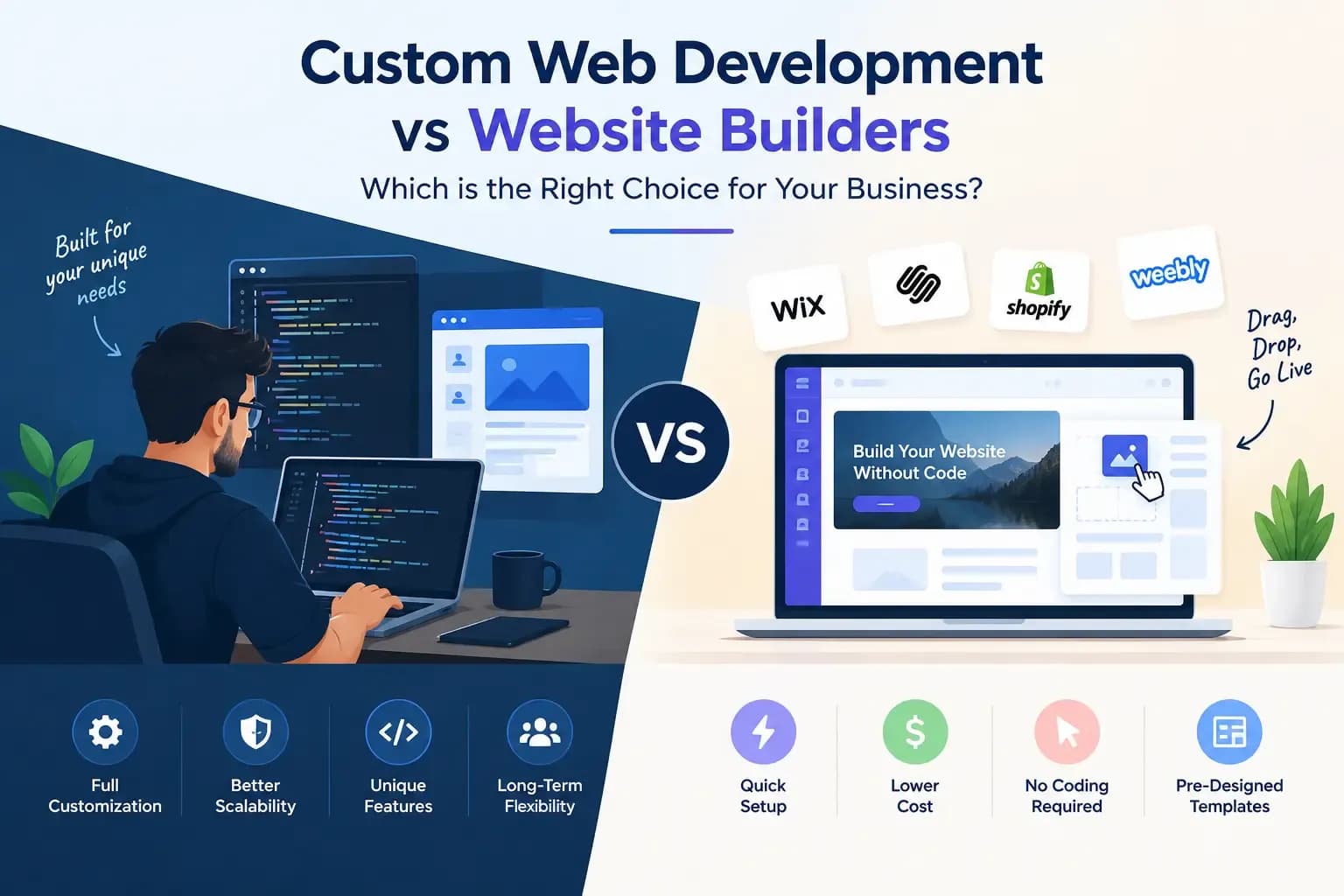
A website builder gives you an existing environment for creating and managing a website. You usually work with templates, visual editors, built-in features, apps, and platform-specific tools.
Custom web development starts differently. The business requirements come first, followed by decisions about design, functionality, data, integrations, and technology.
Consider two businesses. A local accounting firm may need service pages, team information, a blog, contact forms, and consultation requests. A website builder can handle that type of project without much difficulty.
Now consider a company that needs customer accounts, document uploads, automated quotations, online payments, staff permissions, and a private dashboard. That is closer to a web application than a simple business website. The technology choice starts to matter much more in the second case.
Website Builder vs Custom Development at a Glance
Neither option wins in every situation.
A builder can be the smarter choice for a straightforward website. Custom development earns its place when the project has requirements that standard tools cannot handle comfortably.
When Does a Website Builder Make Sense?
For many businesses, a simple website is exactly what they need.
Suppose you run a small consulting company. You want potential clients to understand your services, read a few articles, see your credentials, and contact you.
There may be little reason to build a custom system for that.
A website builder can reduce development time and let the business team handle routine changes themselves. That can be particularly useful for new businesses that are still testing their market.
It also avoids spending heavily on functionality that may never be used.
If the website's job is mainly informing visitors and generating enquiries, keeping the technology simple can be a sensible decision.
Limitations of Website Builder
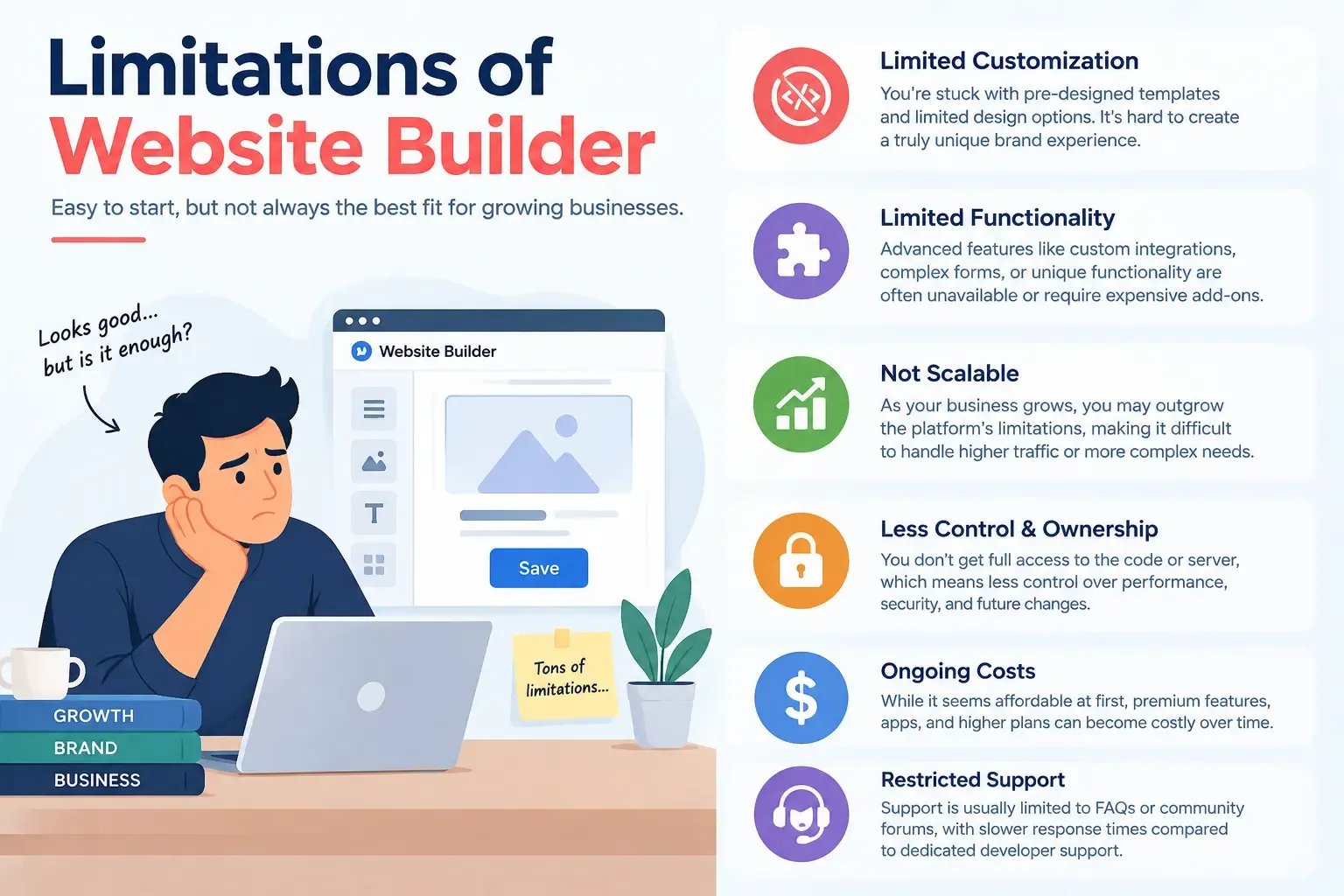
The situation changes when the website starts doing more than publishing pages.
Imagine an online store that initially sells 20 standard products. An established ecommerce platform may be more than enough.
Later, the business introduces customer-specific pricing, product configuration, a quotation system, different account permissions, internal reporting, and connections to several external systems.
The platform may still support some of these features through apps or APIs. The question becomes how well those additions work together.
Too many extensions can introduce their own subscriptions, compatibility issues, maintenance requirements, or limitations. A feature that looks simple from the customer's side can sometimes require considerable work behind the scenes.
This does not mean website builders are incapable of complex projects. Modern platforms can be powerful. It simply means the project should be evaluated based on its actual requirements rather than the number of templates or plugins available.
Custom Development Can Make a Difference
Business Workflows
Businesses rarely operate exactly like the examples built into a template.
A logistics company may need shipment tracking. A property platform may need separate access for agents, owners, and customers. An education platform may need student accounts, instructor dashboards, course progress, and certificates.
These requirements are part of the product itself.
Custom development allows the underlying system to be designed around those processes instead of trying to squeeze them into a standard page structure.
Integrations
A website may need to exchange information with software that already exists inside the business.
That could be a CRM, payment gateway, accounting platform, inventory system, email platform, analytics service, or internal database.
If the required integration already exists for your chosen platform, there may be little development work involved.
If it does not, the project may require API development or a custom integration. Inforisen's software development service includes API and system integration alongside web and application development.
User Experience
A template is designed to work for a broad range of businesses.
Your customers may not behave like the average user the template was designed for.
Consider an industrial supplier whose buyers need to compare technical specifications before requesting a quote. A basic product grid may not provide the best experience. A better interface could include advanced filters, specification comparisons, downloadable documents, and a guided quotation process.
That is where custom design can become useful.
Inforisen's UI/UX design service focuses on user flows, wireframes, prototypes, responsive layouts, accessibility, and iteration based on feedback.
Performance
Custom development gives developers greater influence over the technical implementation, but it does not guarantee a faster website.
A poorly developed custom site can be slow. A well-built site on a managed platform can perform very well.
Google's current Core Web Vitals guidance recommends an LCP of 2.5 seconds or less, INP below 200 milliseconds, and CLS below 0.1 for a good user experience. These metrics are useful for evaluating performance, but passing them does not guarantee high search rankings.
So performance should be treated as something to measure and improve rather than a natural consequence of choosing custom development.
Future Features
You do not need to build every future feature on day one. In fact, doing so can waste money. But there is a difference between avoiding unnecessary development and ignoring requirements that are already predictable.
If a business knows that it will eventually need subscriptions, customer accounts, automated onboarding, or a private dashboard, those plans should at least be considered when choosing the architecture. That can prevent an inexpensive first version from becoming difficult to extend later.
What Does Custom Web Development Actually Give a Business?
Custom development is useful when the website needs functionality that is closely tied to the company's operations.
For example, imagine a service business where a customer needs to:
- Create an account
- Submit project details
- Upload documents
- Receive a quotation
- Approve the quotation
- Pay online
- Track the project
That process involves much more than page design. There are users, permissions, data, notifications, payment logic, and a dashboard to consider.
Inforisen's own web-development guidance lists customer portals, custom payment processes, multiple user roles, automated reporting, advanced search, inventory systems, API integrations, and custom web applications among common custom-development use cases.
For projects like these, the development approach needs to accommodate the actual workflow.
Is Custom Web Development Better for SEO?
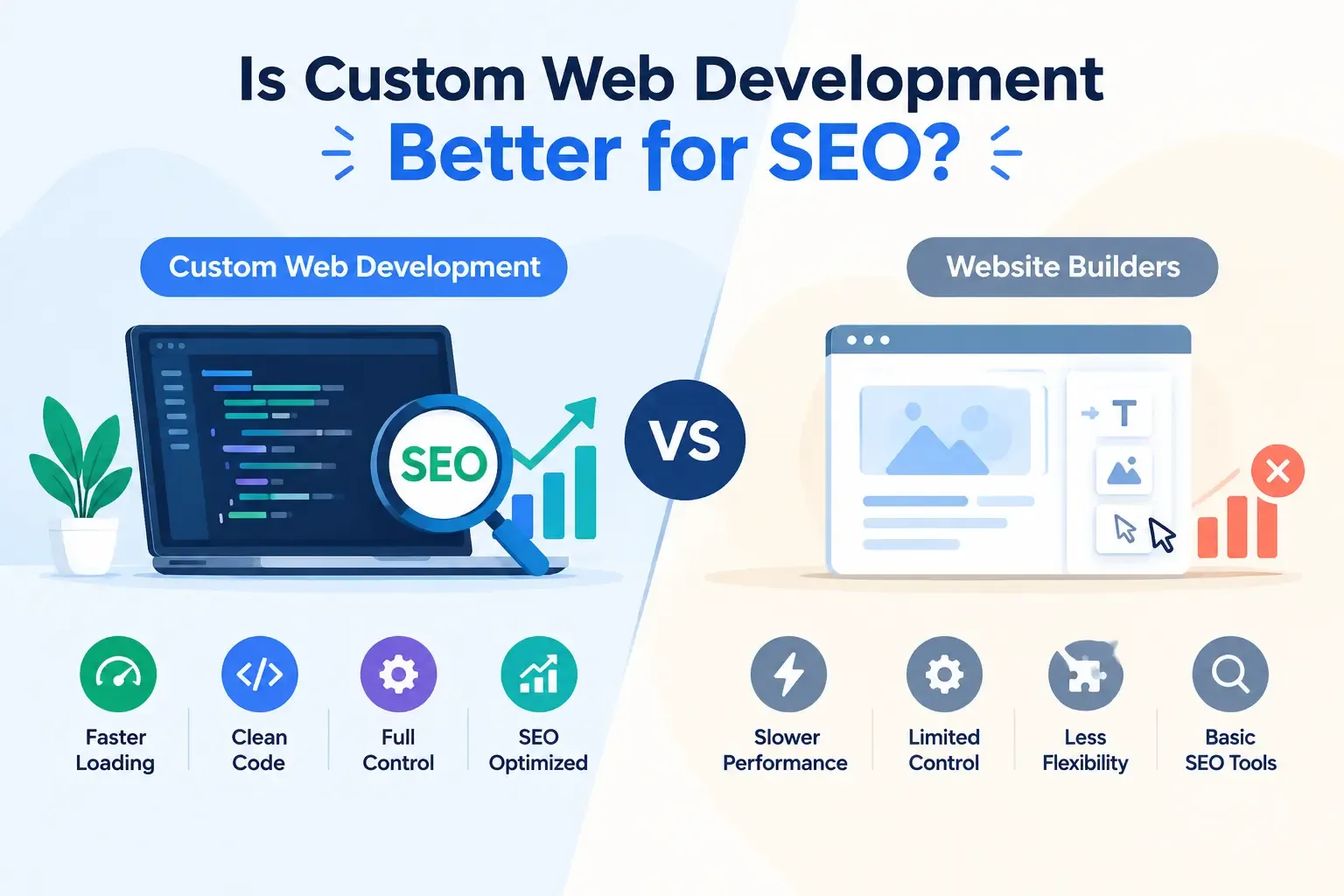
Not automatically. A custom website can give developers more control over technical elements such as URL structures, rendering, page templates, code, structured data, internal systems, and performance. But none of that guarantees rankings.
A website builder can also support SEO effectively for a normal business website. What matters is whether the platform allows the business to create accessible, useful, crawlable, well-structured pages and maintain them properly. Inforisen's guide on how to improve website SEO covers technical SEO, search intent, internal linking, page speed, mobile usability, crawlability, and content quality.
Custom development becomes more relevant when SEO requirements themselves are technically unusual—for example, a large site with complex page generation, specialized filtering, or a highly customized content architecture.
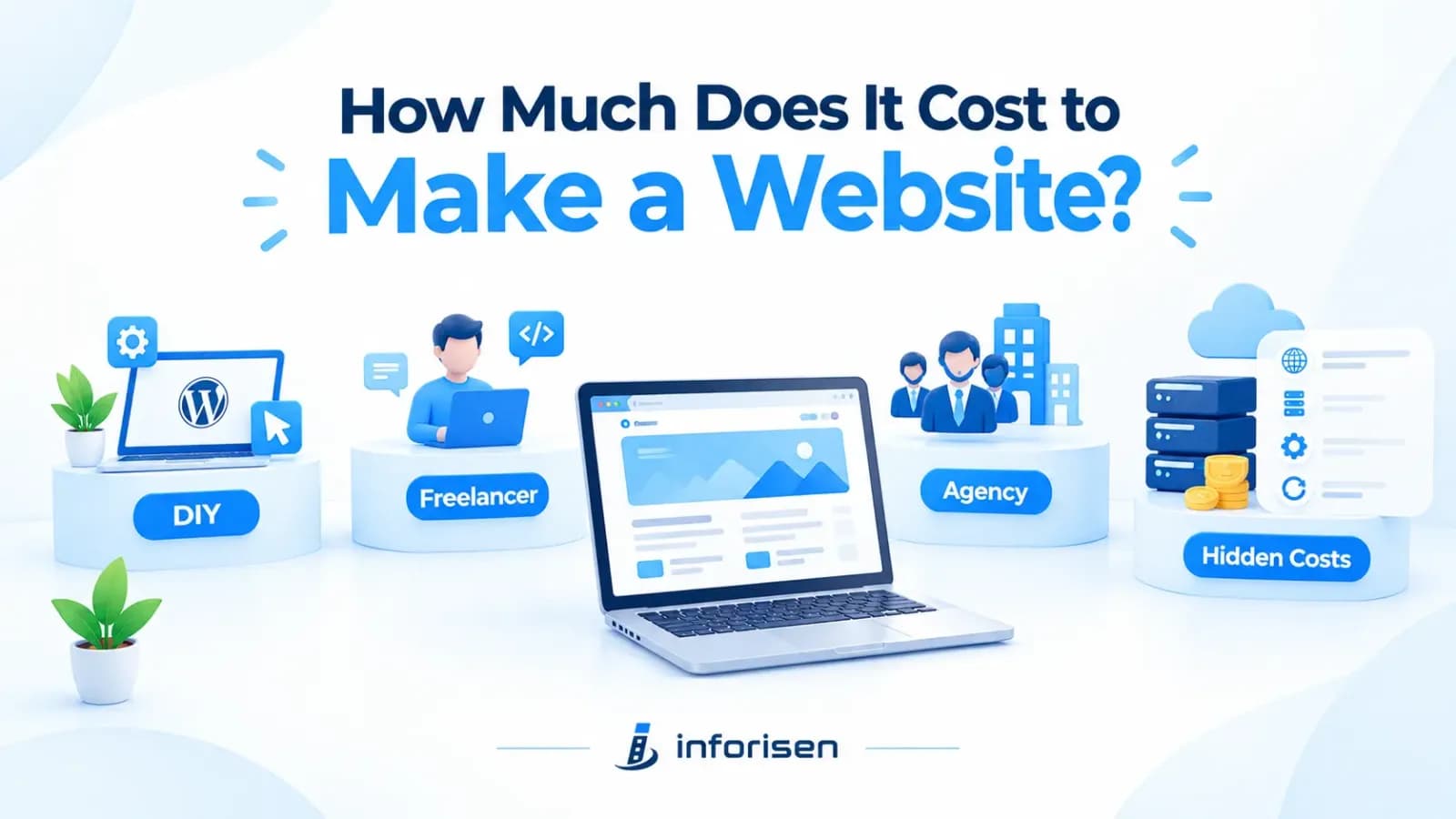
Custom Web Development Cost
There is no fixed price for a custom website because the word “custom” can describe very different projects. A small custom business site and a SaaS platform may both be custom-built, but the amount of design, development, testing, infrastructure, and support involved can be completely different.
Inforisen's current 2026 website-cost guide publishes these ranges:
These are Inforisen's published estimates, not universal market prices. The actual budget depends on page count, design complexity, functionality, integrations, content, technology, testing, and support.
For a deeper breakdown of website costs, the Inforisen website cost guide explains how project type, features, development method, hosting, and ongoing maintenance affect the final budget.
Website builders have a different pricing model because much of the platform infrastructure is included in a recurring subscription.
That means the comparison should not simply be: cheap builder vs expensive custom website. Instead, compare the actual features, development work, platform costs, maintenance, and expected lifespan of the project.
What About Maintenance?
This is an easy cost to overlook. With a website builder, the platform provider handles much of the underlying infrastructure. You still have to manage your content, settings, apps, subscriptions, and website configuration, but you are not maintaining the entire technical stack yourself.
A custom website needs a more deliberate maintenance plan. That can include security updates, backups, monitoring, bug fixes, hosting, performance checks, dependency updates, and future development. This does not make custom development inherently more expensive in the long run. It simply means technical ownership comes with responsibilities that should be included in the budget.
Should a Business Start With a Builder and Move Later?
Sometimes that is the sensible path. A startup might need a landing page, a few service pages, and a lead form while it tests whether people actually want its product. A builder can get that first version online without a large development project.
But consider a different startup that already knows its product requires user accounts, subscriptions, dashboards, and automated onboarding. Building the first version on a platform that cannot comfortably support those requirements may create unnecessary migration work later.
The decision should therefore be based on how certain the requirements are, not simply on the desire to spend less at the beginning.
Finding the Right Fit for Your Business
There is also a middle ground. A company can use an established CMS or ecommerce platform for standard functionality and develop only the components that need special treatment.
That can be a better fit than either building everything from scratch or forcing the entire project into a template.
How Should You Make the Decision?
Start by listing what the website needs to accomplish. Do you need five to ten pages, a blog, contact forms, basic analytics, and standard ecommerce?
A builder or established CMS may be enough. Do customers need accounts? Will employees have different permissions? Does the site need to calculate prices, connect multiple systems, manage large amounts of data, or automate part of the business? Those questions point toward a more customized solution.
It is also worth looking beyond the launch date. If the business already has a clear roadmap for subscriptions, customer portals, automation, or other major features, bring those requirements into the technical discussion before development starts.
Inforisen's Approach to Website Development
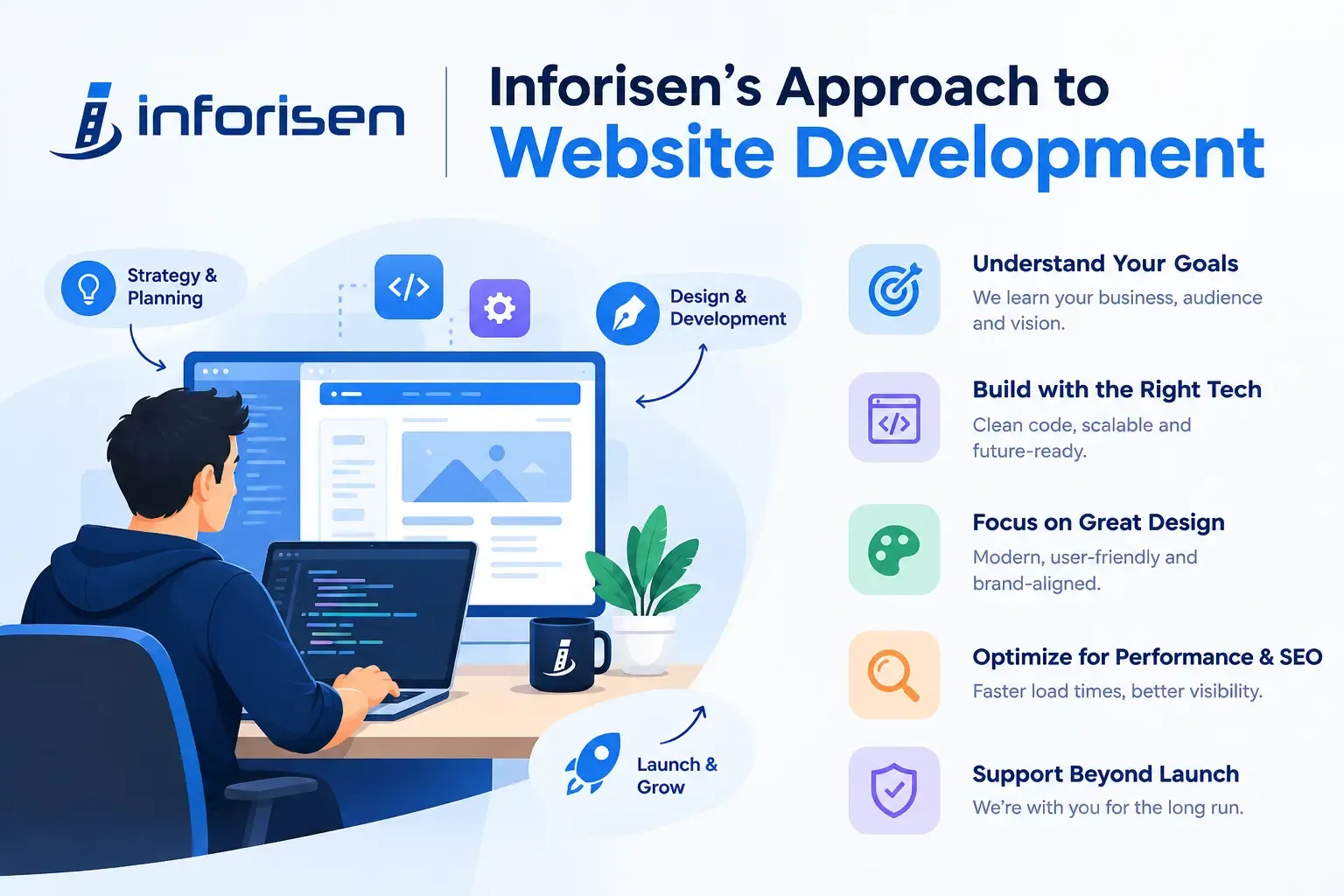
Inforisen provides both website design and development and broader software development, so a project can be matched to its actual requirements rather than automatically treated as one type of website.
Its website design and development service covers custom website design, WordPress development, ecommerce, landing pages, redesigns, maintenance, and custom applications. The published process moves through discovery, planning, design, development, testing, and launch support.
For projects that require application level functionality, Inforisen's software development service covers areas such as web and mobile applications, APIs, integrations, and software development.
And if you are comparing potential development partners rather than technologies, Inforisen's guide on how to choose a web development company covers portfolio, technical skills, pricing clarity, communication, timelines, and after launch support. The useful part is not simply having these services available. The project should first establish what needs to be built and why.
Final Words
Website builders have made professional web presence much more accessible. For a straightforward business website, that can be a very good thing.
Custom development is worth considering when the website has a job beyond presenting information—such as handling customer accounts, business rules, integrations, specialized transactions, or application-like functionality.
You do not need custom code just because your business is growing. You need it when the requirements justify it. Likewise, choosing a website builder is not taking a shortcut if it already provides everything the business needs.
Start with the work the website has to perform. Then choose the technology that can handle that work without adding unnecessary cost or complexity.
Frequently Asked Questions
Is custom web development better than a website builder?
Not in every situation. Website builders are often practical for standard business websites, while custom development becomes more useful for specialized workflows, applications, integrations, and complex functionality.
Is a website builder cheaper than custom development?
Usually, the initial investment is lower. Builders spread much of their cost through recurring platform fees, while custom development requires more upfront design and development work. Maintenance and future changes should also be included when comparing total cost.
Can a website builder rank on Google?
Yes. A website does not need to be custom-built to rank in search engines. A builder can support SEO when it provides the necessary technical controls and the site has useful, relevant content and good overall SEO practices.
When should a business choose custom web development?
Consider it when the website needs customer portals, complex booking or quotation systems, multiple user roles, unusual integrations, advanced business logic, or other functionality that standard platform features cannot comfortably provide.
Can a custom website use WordPress or another CMS?
Yes. Custom development does not mean avoiding established platforms. A business can use a CMS for content while developing custom functionality where needed.
Can a website builder be converted into a custom website later?
Yes, although the difficulty depends on the platform, existing data, integrations, and new requirements. Some businesses gradually add custom functionality, while others eventually migrate to a different platform or application architecture.
Is custom development necessary for a small business?
Usually not for a simple informational website. It can make sense for a small business if its website needs a specialized booking system, customer portal, quotation engine, marketplace, or another application-like feature.

.webp&w=3840&q=75)


.jpg&w=3840&q=75)